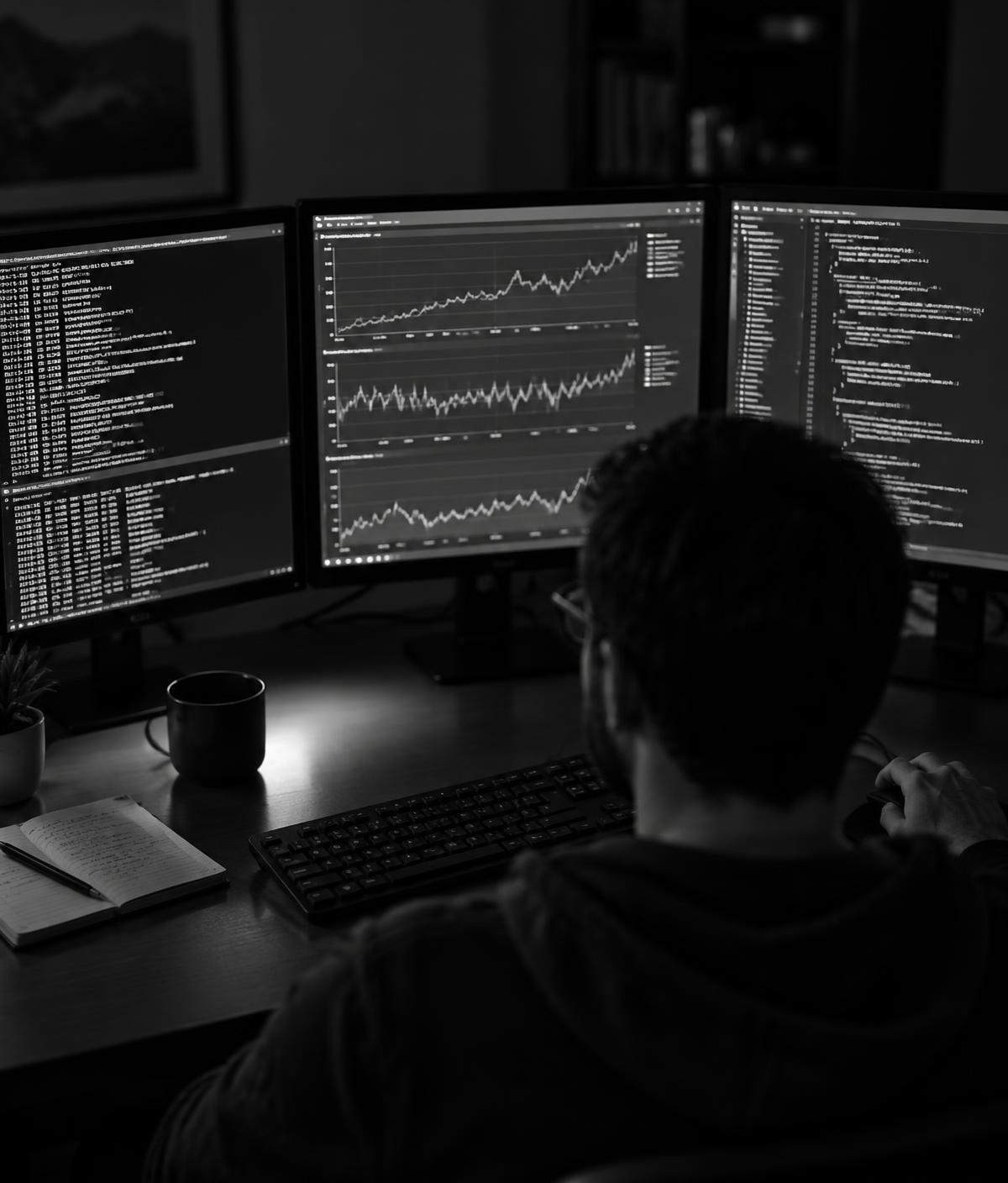
Systems, from model to metal.
A market making system is a chain of decisions made in parallel, thousands of times a second. We design every link in that chain ourselves.
Research produces the model, engineering makes it run continuously, and the two are held to the same standard: say why it works, and be able to prove it after the fact.
Who we are
Four problems, one model.
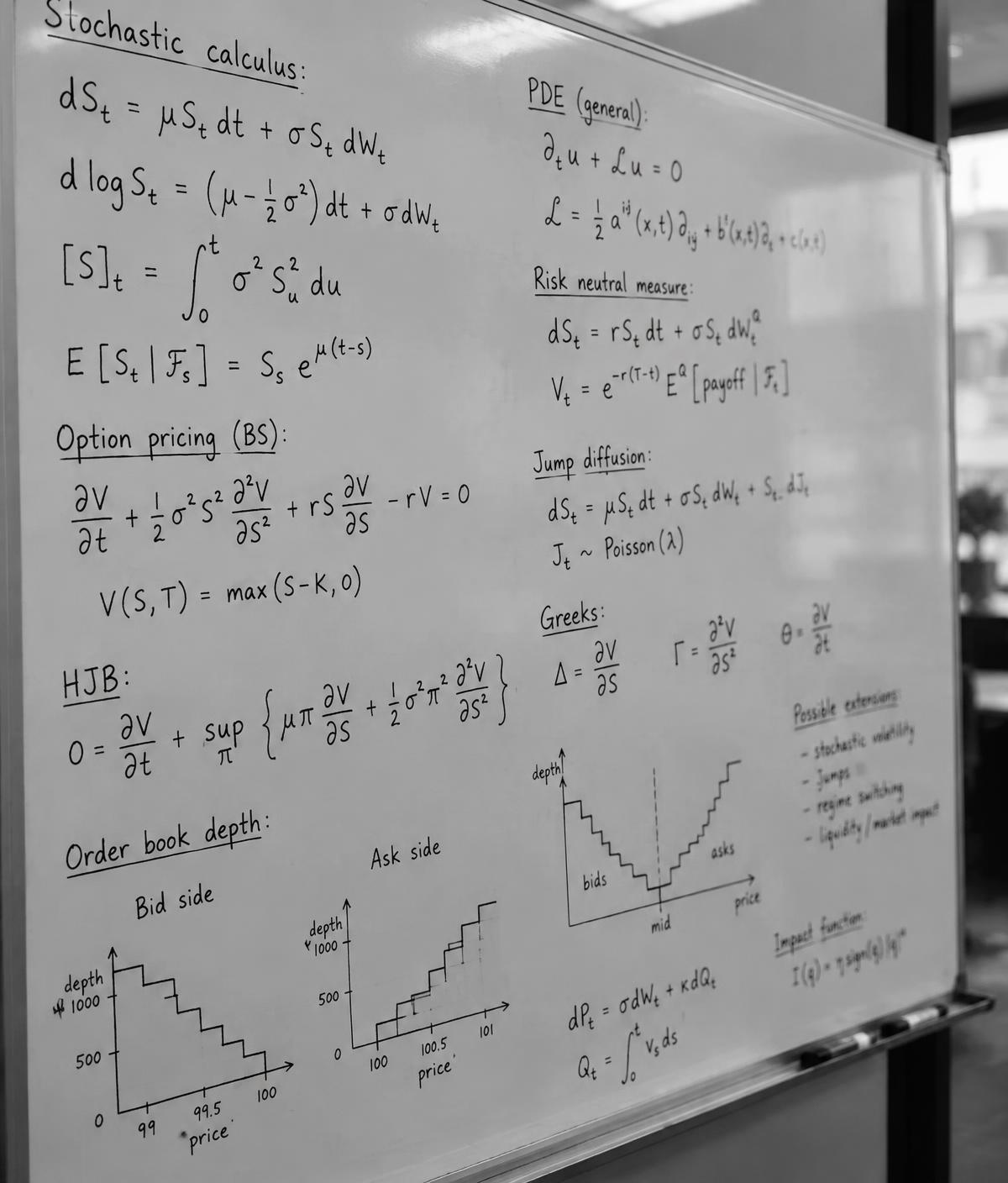
Quoting a market well means answering several questions at once: what the book is about to do, what it will cost to be in it, and what our own presence does to the answer. We treat them as one problem rather than four.
Microstructure
Order book state reconstruction at nanosecond resolution. We model queue position, queue depletion, and adverse selection venue by venue, then price the difference between a fill we wanted and a fill we were handed.
Stochastic Volatility
Continuous recalibration of quoting surfaces against realised and implied volatility across correlated spot and perpetual books. Parameters move because the market moved, not because a schedule said so.
Inventory Control
Closed-loop hedging policies that keep book exposure inside strict bounds without widening quoted spreads. Every position has an owner, a limit, and a defined path back to flat.
Market Impact
Models of our own footprint: what a resting quote does to the book it sits in, and what a hedge does to the venue it crosses. We price the cost of being seen before we take it on.
Five layers, one build.
Nothing here is bought and assembled. Each layer is written, owned, and maintained by the people who depend on it, which is the only way a change can move from idea to production without a handoff losing the reasoning behind it.
Market Data
Venue connectivity, feed handlers, and order book reconstruction. Every event is timestamped on ingest so a model sees the book at a known instant rather than an approximation of one.
Models
Pricing, forecasting, and inventory policies live in one research platform. A researcher changes a model without touching the execution path, and that change is testable before it is ever live.
Execution
Deterministic order paths, kernel-bypass networking, and hardware acceleration where it earns its keep. The route an order takes is documented, measured, and reproducible.
Risk
Pre-trade limits, position bounds, and kill criteria evaluated on every action. Risk runs in the same loop as quoting, not downstream of it.
Tooling
Simulation, replay, deployment, and telemetry. Any day in any market we trade can be replayed on a laptop, which is how a change gets argued for or argued out of the way.